Showing posts with label autism. Show all posts

Jan 15, 2012

Staying in the loop

Yesterday I went to an Autism and ADHD workshop. It was hosted at my church building and put together by church members though some presenters were not LDS and it was open to the public. 

I thoroughly enjoyed going to the meeting, mostly because it reminded me of all the wonderful experiences I had student teaching. I love the students I worked with and have fond memories of my time with them! 

Also, it's important for me to stay current with my field. Even though I don't plan to work after having my baby, I'm still passionate, and will still be passionate about kids with special needs. Ironically, or hypocritically, I haven't been reading recent news or events regarding teaching those with disabilities - hence no blog posts about it, haha. But hey, as much as I may try, I can't do everything. I just haven't admitted that yet.

So here's a mini story to get back into the groove of things. Jacob was 7 years old when a speech therapist taught him to type and therefore express himself. Jacob is nonverbal and is diagnosed with autism and mental retardation. Well you can read how the therapist taught him to type in this huffington post article. The therapist would ask Jacob to type something, and then she would physically guide him to type out the answer. (At this point in the story I scoffed - sure, she's "guiding" his hands...) Jacob has never been taught how to read and has showed few signs of communication throughout his life. Naturally I was quite skeptical of this whole scenario, and I still am, but apparently, he is now 19 and communicates with his parents via typing. How amazing is that? I gained confidence again that Jacob in fact did learn how to type and communicate with others and that his mental retardation was misdiagnosed. But then why, 14 years later, is the same speech therapist teaching him how to type? If he is intelligent, and can communicate and type on his own, then why does he still need her help?

Two things. 1. I sincerely hope I am misjudging the speech therapist and that these incongruencies are easily explained. 2. Regardless of the truthfulness of this story, people who are nonverbal have thoughts too. It just takes a little creativity to help them express those thoughts. 

I'll close with Jacob's own thoughts: "For people with autism, every day is an unending struggle to remember that we are not so different after all. You can help by smiling at us, by welcoming our presence and encouraging our participation. In the end, it comes down to recognizing God's image in every single human being."

What are your thoughts?


Sep 27, 2011

Independence

What an absolutely delightful story. It is of a young adult, Justin Canha, who is transitioning to the real world - he also has autism. You will not regret reading all 10 pages of this NY times article! Autistic and Seeking a Place in an Adult World.

"In 'Jickey Goes to Behavior Therapy,' Dr. Fanky P. Wolf gets his eyes gouged out by his patient, Jickey, whom he is prodding to make eye contact."
One of Justin's cartoons.
If you don't have time to read the article, watch the video (though it's not nearly as comprehensive): http://video.nytimes.com/video/2011/09/17/us/100000000972826/the-practice-round.html

Jun 8, 2011

I find this quite hard to believe...

This article reviews the CDC study that found 1 in 6 US children (ages 3-17) have a developmental disability. I haven't read the actual study so I will be brief about this.

Background
There have been several studies showing that autism, adhd, and other diagnoses are more prevalent now than ever. The common man criticizes those findings saying, "they are finding what they want to find" or "autism is not more prevalent, but now that we know more about it, we can better find it."

Issue
True or not true: autism, adhd, and/or developmental disabilities are more common now than 10 or 20 years ago?
What I think
No. The article mentions causes behind the rise in diagnoses: "Researchers said the increase may be due in part to more preterm births and parents having children at older ages. They also said that improvements in screenings, diagnosis and awareness have pushed the numbers higher." If anything, I think it's the latter. I find it hard to believe that cases of these disabilities are rising by 30+% per year! At this rate, in a few years, all of our children will have some diagnosis.

What struck me was how the data was collected: "The surveys are representative samples of U.S. households and asked PARENTS to report diagnoses of ADHD, mental retardation, cerebral palsy, autism, seizures, stuttering or stammering, moderate to profound hearing loss, blindness, learning disorders and other developmental delays." PARENTS. Did you catch that? Do you see anything wrong with that? I do. Parents are not doctors and (no offense please) without the training and experience, can we trust their diagnosis of their own children? Yes, they know their child better than anyone. Yes they can research up on adhd (click here to learn what the symptoms are and you'll find that all children show some or most of them at one point in their lives). But I can't trust these surveys to accurately represent the disabilities that these children have.

Note: I am not discounting the reality of these disabilities, this is why I went into Special education after all...just the sudden and extreme rise in numbers.

Am I being unreasonable? What do you think: is the rise in cases of autism, adhd, and developmental disabilities legitimate?

Apr 12, 2011

Therapy

This is awesome. I wish opportunities like this were available for all people, not just those with special needs! (oh wait, they are...still, it's super cool) I think that activities like these: painting, sculpting, interacting with animals, etc, do a lot for a person's self esteem. 

Source
I'm definitely not the expert on the impact that an animal can have on a person's health (please step in if you are) but I believe that it is beyond beneficial. I know of several families who got a dog primarily to help their son with autism cope. One mother specifically said that her son does not stutter when he talks to their dog, but he does when he talks to people. Animals simply don't judge people and I think that if you feel misjudged or misunderstood a lot, animals can be a relief from person-person interaction.

Source
P.S. I learned that it's called Animal Assisted Therapy. Here's a cool website about it.

Apr 4, 2011

Medicating children with Autism

I realize I haven't posted about Special Ed. in a while. That's because I really haven't come across anything too exciting and controversial. I also realize many of my sped posts seem to be about autism. That's probably because a heck a lot of the new research is about autism, most of my experience is with students who have autism, and it's super interesting to me. So here's another post about autism.

Source
Background: Because autism is prevalent in our society (1.1% of children are diagnosed with autism spectrum disorder (ASD) according to the center for disease control and prevention (CDC)) more and more people are looking for solutions, treatments, etc. Parents make up a huge portion of the population looking for treatments. Unfortunately, parents are not an unbiased party and tend to look for someone or something they can blame (MMR vaccines is a common one - which the British Medical Journal declared fraudulent earlier this year by the way) and some miracle way to fix it (diets, behavior therapies, sensory therapies, and others).

Issue: A new analysis of studies has concluded that most of autism treatments "fall short;" meaning that they are not effective for populations of people with autism. Note: there have been individuals who have had successful results with medication. Recently, there was a small breakthrough in research that may connect autism to a single gene (HOORAY! - though my excitement may be short-lived, this "breakthrough" has happened several times before). Let's continue with the assumption that we have not yet found a one-all be-all solution and ask ourselves: is it worth it to medicate your child with autism hoping that this particular medication will work for your child?
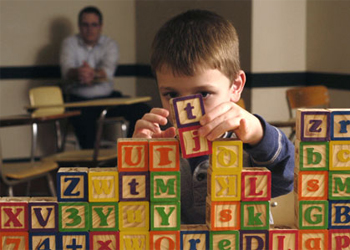
If you immediately understand this picture, you understand autism. haha.
A common trait found in autism is stacking, organizing, piling, lining up, etc.


What I think: This is a super tough question for me. I do not have a child with autism so it is hard to go with my gut and say "no I would not medicate my child." Not because I don't believe in medicine and not because I'm okay with the behaviors that come along with autism, but because research currently shows that they do not work. If the medication did not have any side effects, then sure, no biggie. But there are side effects. Big ones. And I don't think it's worth it to medicate my child when the chance of it working is smaller than the chance of serious side effects. 

But, like I said, I am not a parent of a child with autism. I'm not the one with sleepless nights because my child wakes up in the middle of the night, unlocks the door, and wanders outside. I'm not the one who deals with the random tantrums, with the headbanging, with the lack of communication, with the social ostracism from church and community. I'm not the one with the heartache of watching your child rejected by his peers. I'm not the one whose child doesn't say "I love you too." Of course I would want a solution. I just don't believe that the solution can currently come through medication.

Mar 11, 2011

Maybe I was wrong.

Ipads and Autism - Still, I maintain my previous opinion. I would like to see some real research done on this issue.

People with Disabilities in the Media - I thought that people were being portrayed incorrectly. Fortunately, this is changing. (Kudos to Brian for being right :).)

Feb 17, 2011

ipads - do they really help?


There is this new technology fad in the field of special education: the ipad. Don't believe me? Google search, "ipad autism" and you'll find hundreds, if not thousands, of relevant, recent results.

Background: Much of the population that I work with is nonverbal. Communicating with them and teaching them requires a little bit of creativity :). Technology has been one major avenue that people with disabilities communicate with others. Quintessential example: Stephen Hawking. He uses the DecTALK. He enters text with his cheek, the DecTALK transforms that text to speech. Through this communication device, Hawking has changed the world of science because of his talents.

Issue: Ipads are the new thing. Practically every week I hear/read a story about ipads in special education classrooms. Teachers are writing grants and studying the use/effect of ipads in the classroom. The ipad has obvious benefits for students with disabilities. 1. There are many apps for educational, enriching games for children. 2. It can be used as a communication device. 3. It may engage children in ways that teachers have not been able to. 4. It is extremely inexpensive (compared to the tens of thousands of dollars other communication devices cost). It seems like the ipad is perfect. But what happens when teachers expect to have an ipad for each student in their class. It's hard to argue against the growing evidence that the ipad works.

Special education graduate student Mary Beth Litsey helps a student learn how to use a specially-modified iPad designed to help improve the communication and social skills of children with autism.

What I think: I am instinctively apprehensive and almost critical towards the idea that technology can solve everything in the field of education. I think special educators tend to be more prone to this technology philosophy; we have lots of problems that we can't seem to solve, so maybe technology can do it for us. 

My personal opinion is that there is not an "end all be all" solution. Each child will have their own needs and their own strengths (even within the autism spectrum). In my student teaching, we informally experimented with the ipad and a couple of our students. We tried to engage them with apps similar to those in the videos below. We tried to use the ipad as a communication device. We prayed (at least I did) that this would be the breakthrough we needed to get to this child. We only tried for a month, so maybe we needed more time, but we didn't see any success. On the other hand, I sincerely believe the ipad can be the device that opens up these children to our world so that we can truly see their talents.    

In many instances, technology does help, but that does not mean it will be useful for every student, or that every student needs and ipad to be successful. I think teachers, districts, and parents need to determine if an ipad is needed on an individual basis.

Real stories:

A boy with autism participates more fully in his classroom:Taylor Parrish finds his voice using technology

Abbey, a young girl with autism, plays with the ipad:  


Abbey asks for water:

Feb 3, 2011

If I could go anywhere, anytime. . .

This is what I would do from June 27- Jul 1: http://ies.ed.gov/whatsnew/newsletters/?index=roundncser
Too bad it's in Wisconsin, and I'll be in NY.

The training would be about single-case experimental research:
"Single-case experimental research plays an important role in the development of evidence-based practice in special education, and is used by researchers in an array of disciplines. The technique is particularly important for special education researchers who study low-incidence disabilities for which group design is not feasible." aka, me.Alas, I will just have to learn about it on my own!


I've always wondered how I would do this as a teacher. If my student has Autism, the research is overflowing. If my student has cri-du-chat, there is still much research. But what if my student has multiple disabilties, the combination of which creates a whole new situation, the research is only generally applicable. I would be left to my own devices and intuition (which would be fun . . . but probably not as effective as using research-based-practices. So, you can see how this experimental design would be especially intriguing to me.